


Waterproofing Products: Which Type for Each Area?
Waterproofing products should be selected according to the area of use, substrate and level of water exposure. External walls, bathroom floors and basements have different requirements, so the name on the packaging alone is not enough. This article distinguishes between groups of waterproofing materials, explains how to compare LEMAN’s waterproofing product range and outlines what to check before choosing.
Contents:
1. What factors should guide the choice of waterproofing products?
2. Groups of waterproofing products and their roles
3. Suggested LEMAN products for each area
4. Considerations when buying and using waterproofing products
1. What factors should guide the choice of waterproofing products?
Before buying, identify where the water comes from: rain penetrating walls, leaks around pipe penetrations or water in the soil in contact with the basement. Similar damp patches can have different causes and require different treatments. Coating the visible area may not address the path through which water enters.
Next, check whether the concrete, mortar or existing finish is compatible with the product’s intended applications. For exposed areas, consider weather resistance; for water-retaining areas, check immersion conditions. This helps narrow down the group of waterproofing materials before comparing individual product lines.
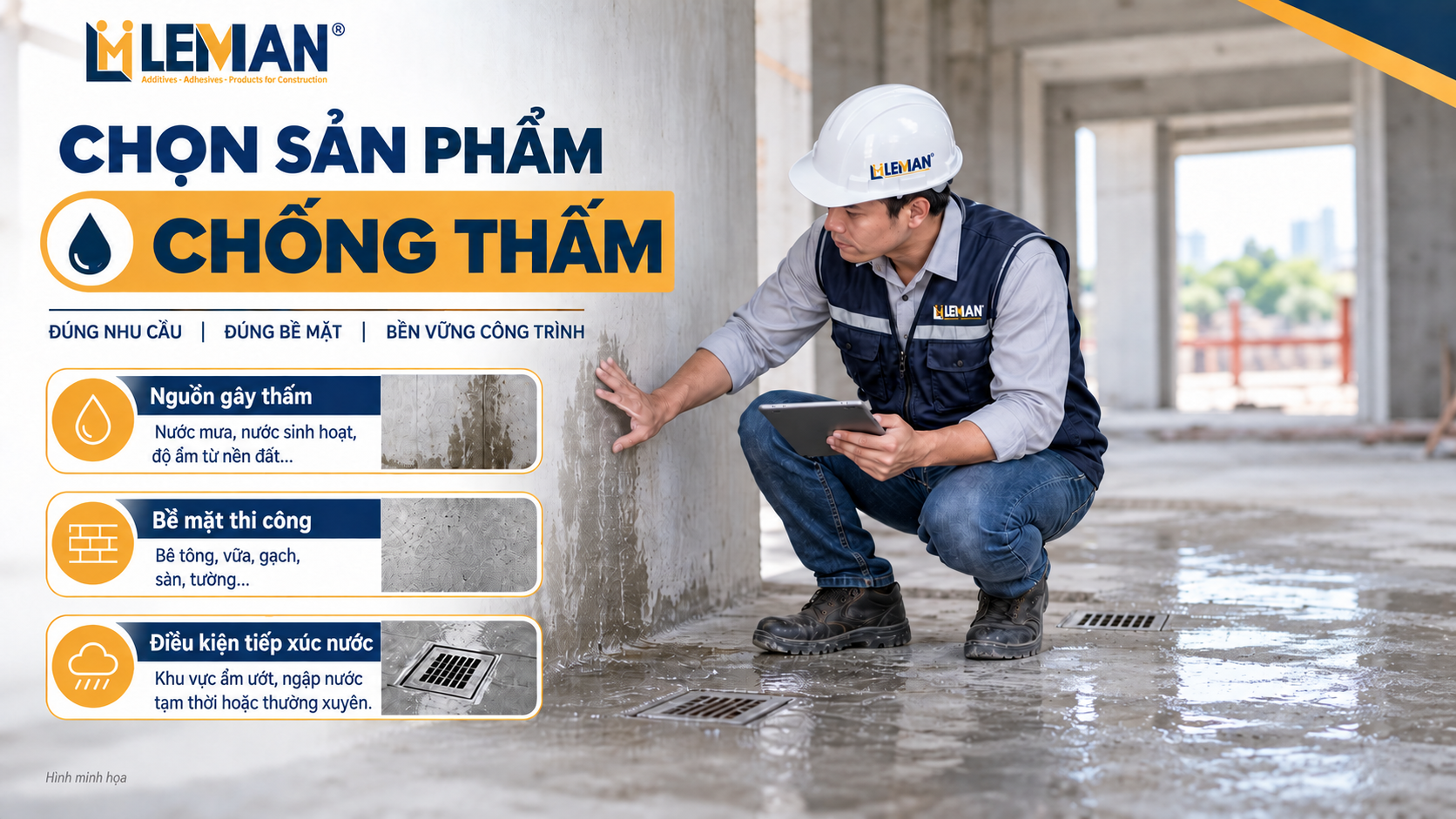
Select waterproofing products based on the source of water ingress, the substrate and water exposure conditions.
2. Groups of waterproofing products and their roles
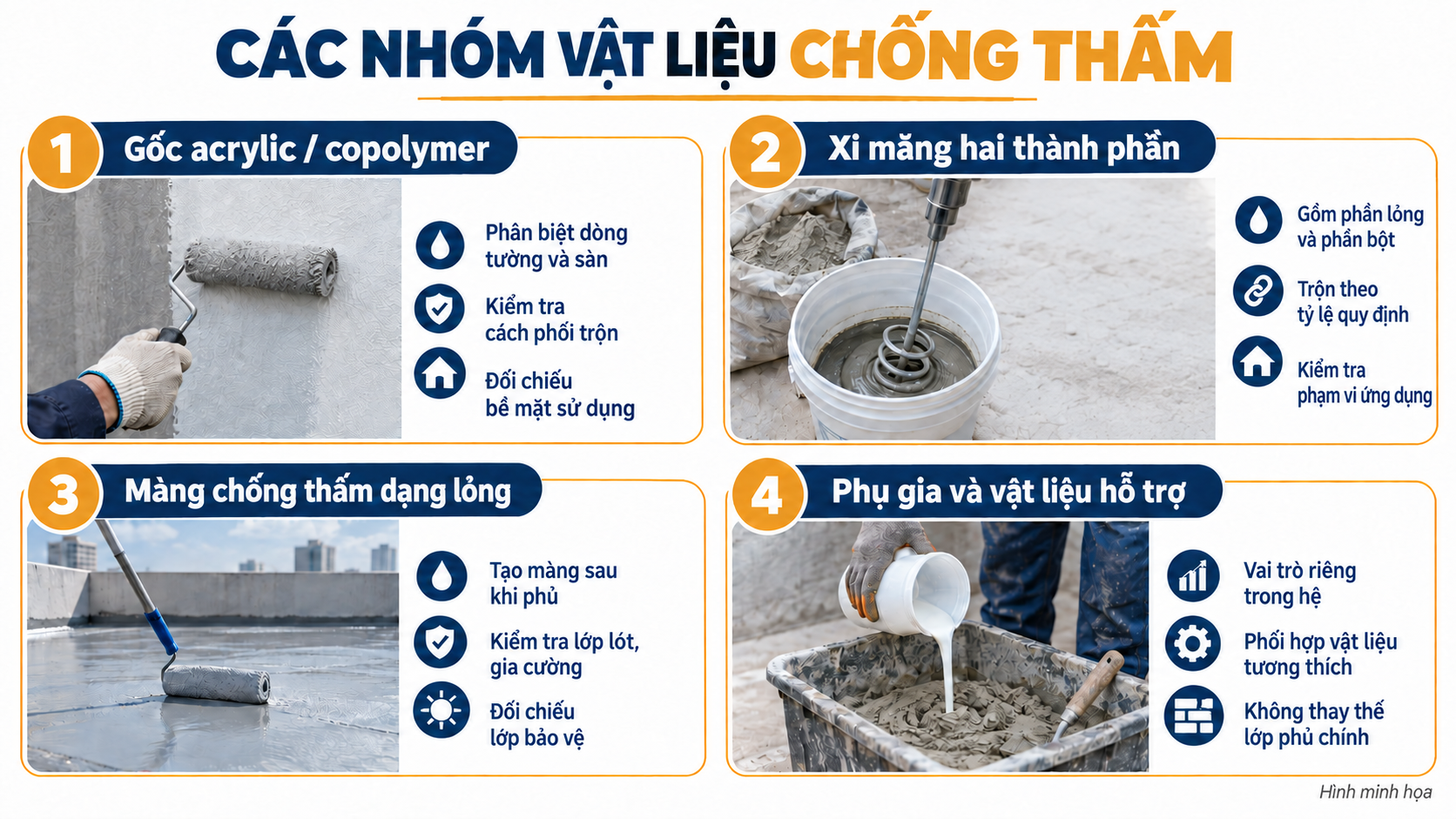
Illustration of waterproofing material groups and the features to consider when choosing.
2.1. Acrylic- and copolymer-based waterproofing compounds
The acrylic- and copolymer-based waterproofing group includes product lines developed for different surfaces. In LEMAN’s waterproofing product range, GUARD AT-11 is used for concrete and cement-rendered wall surfaces, while AT-11 PLUS is suitable for floor surfaces such as roof terraces, bathroom floors, basements and certain other areas according to the manufacturer’s instructions.
Both products are mixed with cement and water in the specified ratios before application. The applications, mixing ratios and surface preparation requirements of each product should therefore be checked against the actual conditions of the project.
2.2. Two-component cementitious coatings
This material system consists of liquid and powder components, mixed in the specified ratio and then applied to concrete or mortar substrates. When comparing products, review elasticity, crack-bridging ability and the intended applications in the technical documentation.
LEMAN AT-14 MAX and AT-15 PRO are two-component waterproofing products. The manufacturer lists applications in basements, water tanks, swimming pools and wet areas. They are used for waterproofing and bridging hairline cracks on concrete or mortar surfaces.
2.3. Liquid-applied waterproofing membranes
These products form a membrane after application to the substrate and are suitable for surfaces with numerous details, subject to each system’s instructions. Check primers, reinforcement materials and protective layers together, rather than selecting only the main membrane.
LEMAN PU 680 is a one-component waterproofing membrane based on a PU-acrylic dispersion. It resists ponding water and UV radiation, bridges cracks and forms a seamless waterproofing membrane. The product is intended for roofs, roof terraces, balconies and areas with many complex details.
The range also includes LEMAN PROOF MEMBRANE, a bitumen-based liquid membrane. The two products should not be used interchangeably simply because both are described as waterproofing membranes.
2.4. Admixtures and supporting materials
Admixtures, primers and materials for treating details each have a specific role in a waterproofing system. For example, LEMAN LATEX A1 is an admixture that must be used according to its corresponding mixing and application instructions.
When selecting waterproofing products, distinguish the main coating from supporting materials. An admixture does not automatically replace a membrane; products used together must be compatible and fulfil their intended roles.
3. Suggested LEMAN products for each area
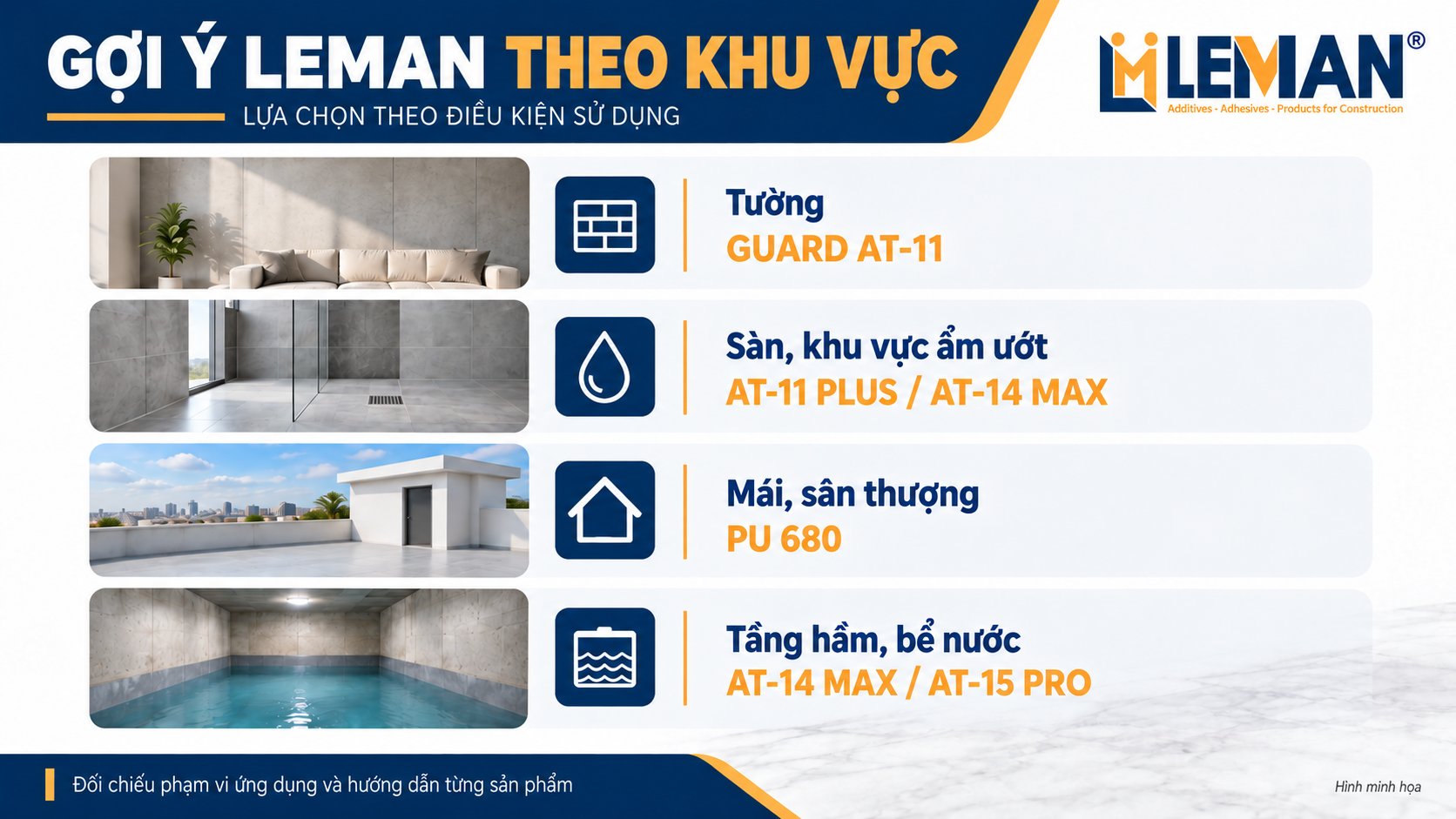
Illustration of suggested LEMAN waterproofing products for different areas of use.
3.1. Choosing waterproofing products for walls
First, inspect cracks, junctions around doors and windows, and water sources behind the wall. LEMAN GUARD AT-11 can be considered for suitable wall surfaces. If the water comes from pipes or the roof, address the source of the ingress before refinishing the wall.
3.2. Choosing products for bathroom floors and wet areas
Floors commonly have pipe penetrations, floor drains and floor-to-wall junctions. In addition to choosing a coating, these details must be treated and suitable drainage provided.
LEMAN AT-11 PLUS or a two-component system such as AT-14 MAX may be considered within the manufacturer’s stated scope. Check the protective layer, tiling and waiting time before flood testing.
3.3. Choosing products for roofs and roof terraces
Distinguish between roofs with exposed waterproofing and those with a protective layer or tiling. For exposed roofs, weather resistance and UV resistance are criteria to consider.
LEMAN PU 680 is intended for roofing applications. Selection must still take account of the slope, ponding conditions, reinforcement options and foot traffic requirements; a waterproofing layer does not replace a drainage solution.
3.4. Choosing products for basements, water tanks and swimming pools
These areas require an assessment of water pressure, the direction from which water acts and the condition of the structure. AT-14 MAX and AT-15 PRO have corresponding applications listed by the manufacturer, but the application system must be selected for the specific conditions.
For tanks storing domestic water, check documentation confirming suitability for the intended use. Do not infer suitability for contact with drinking water solely from the description “water tank waterproofing”.
4. Considerations when buying and using waterproofing products
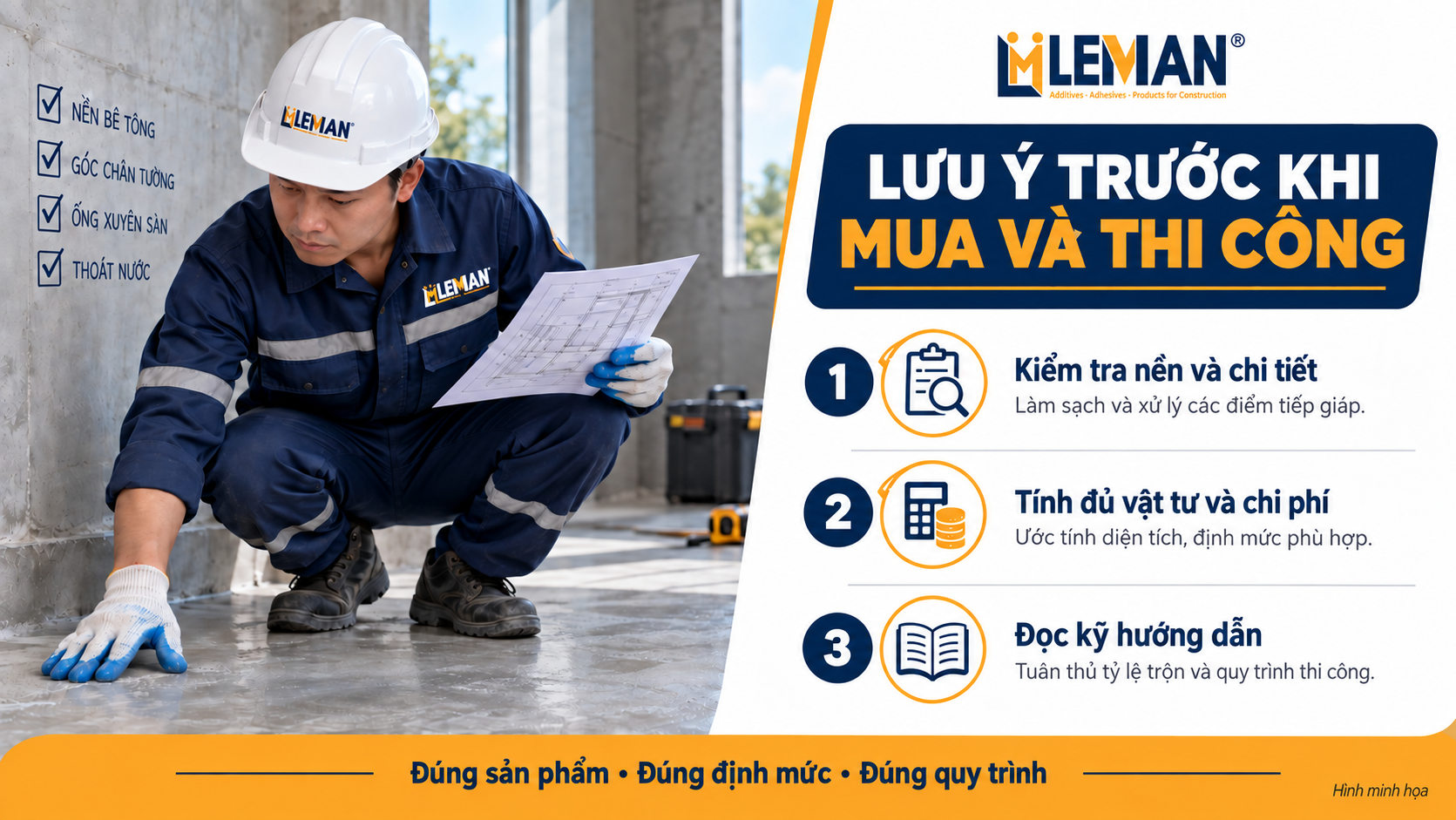
Illustration of considerations before selecting and applying waterproofing products.
4.1. Inspect the substrate before finalising the product
Inspect the surface condition and prepare the substrate according to each product’s requirements. Remove dirt, oil, grease, algae, mould and poorly bonded layers; treat cracks, honeycombing and other defects before applying waterproofing. Also check whether the surface must be dry or pre-dampened, as application conditions may differ between products.
4.2. Compare costs for the complete material system
The price of one container does not reflect the full cost of use. Account for the area, application rate, number of coats, primer, reinforcement, protective layer and labour. Comparing the same scope of work helps match the choice of waterproofing materials more closely to the actual budget.
4.3. Read the instructions and check the packaging
Before purchase and application, verify the product name, expiry date, storage conditions, mixing ratio and waiting times between steps. Do not alter mixing ratios, dilution ratios, application rates or the number of coats beyond the instructions for each product.
Conclusion
Choosing suitable waterproofing products starts with the source of water ingress, the area of use and the substrate. Then compare the material group, intended applications and requirements of the complete system. This approach clarifies the work needed before purchase and matches the product to the actual conditions of the project.
Refer to the LEMAN waterproofing range to compare products for walls, floors, roofs and water-retaining areas. For advice, use the LEMAN contact section to get help choosing based on existing conditions and intended use.


.jpg)


